
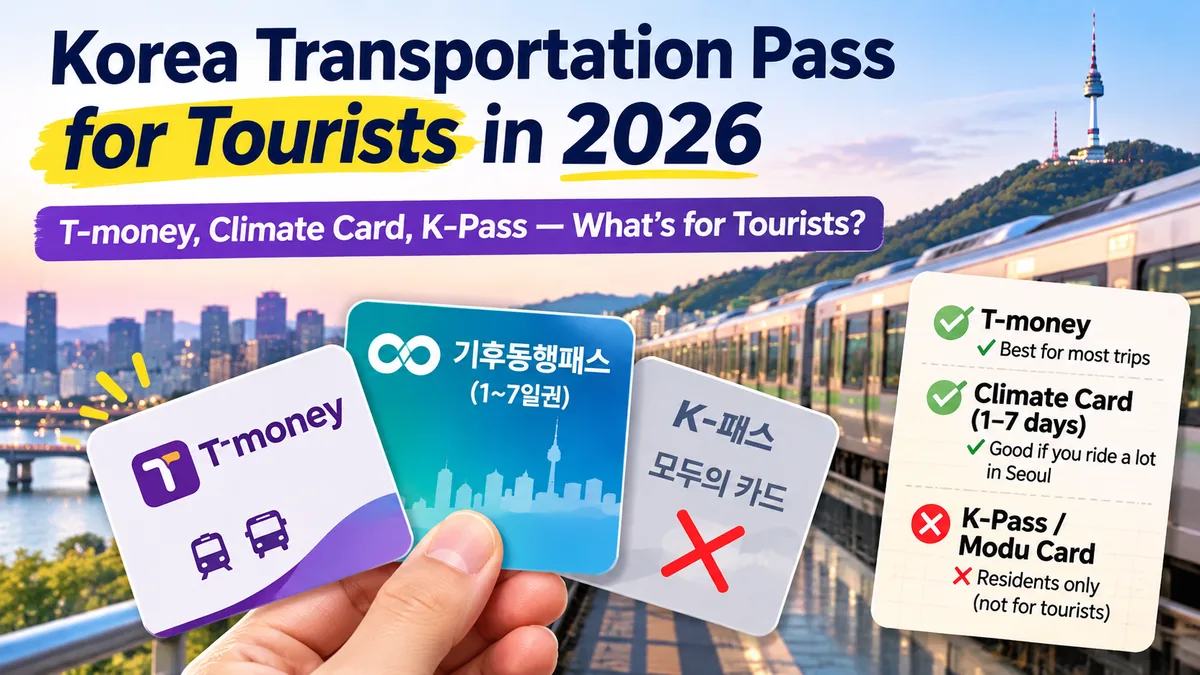
If you’re searching for a Korea transportation pass for tourists right now, I get why you’re confused. In September 2026 Seoul changed its monthly transit pass, the news spread under five different names, and a lot of blog posts still show prices for a card that no longer exists.
Here’s the short version from a local. The 30-day Climate Card is gone, but the 1 to 7 day tourist passes are still sold. K-Pass is a resident program, so you can’t use it as a visitor. For most trips, T-money is still the card to buy.
Table of Contents
- Quick Answer: The Best Korea Transportation Pass for Tourists
- What Changed in September 2026 (and What Didn’t)
- T-money: The Card Almost Every Tourist Needs
- Climate Card Short-Term Pass: 1 to 7 Days in Seoul
- K-Pass, Modu Card and Climate Pass: Not Your Pass
- Which Korea Transportation Pass for Tourists Fits Your Trip?
- Mistakes I’d Help You Avoid
- FAQ
- Final Thoughts
Quick Answer: The Best Korea Transportation Pass for Tourists
| Card | Can tourists use it? | Cost | Where it works | My verdict |
|---|---|---|---|---|
| T-money | Yes | Card about 3,000 won (~US$2.20) + the balance you load | Subways and buses nationwide, AREX airport train, taxis, convenience stores | Buy this for almost every trip |
| Climate Card (1–7 day pass) | Yes | 3,000 won (~US$2.20) card + 5,000–20,000 won (~US$3.70–14.70) pass | Seoul subway and Seoul-licensed buses only | Worth it only if you ride a lot inside Seoul |
| K-Pass / Modu Card | No (residents) | Normal fares, partial refund later | Nationwide | Skip it as a visitor |
| Climate Card Plus / Climate Pass | No (Seoul residents) | Replaces the 30-day card | Seoul and metro area | Skip it as a visitor |
My default advice: buy T-money first. Add a Climate Card pass only if you plan four or more paid rides a day inside Seoul.
What Changed in September 2026 (and What Didn’t)
Seoul used to sell a 30-day Climate Card for residents: unlimited subway and bus rides for a flat monthly price. In June 2026 the city announced it would merge that product into the national K-Pass system under the name "Climate Card Plus."
When it launched on September 1, Seoul’s own FAQ pages called the new resident product the Climate Pass (기후동행패스). You’ll see "Climate Card Plus," "Climate Pass" and "Everyone’s Card" used for the same overall change. It’s the same thing with messy branding.
Here is what actually happened to the old cards, based on Seoul’s official FAQ:
| Item | Status |
|---|---|
| Prepaid 30-day Climate Card | Recharging stopped after Aug 31, 2026. Last day of use was Sept 29. |
| Postpaid Climate Card | Discount applied through Sept 30. |
| Both ended | Oct 1, 2026 |
| Short-term passes (1, 2, 3, 5, 7 days) | Still sold. Seoul only. |
Why did the tourist passes survive? Seoul said the short-term passes can’t be combined with the Modu Card (the K-Pass was renamed), so they stay as a separate product. The city’s FAQ also points people who can’t join the resident system to the short-term passes. You can read the details on Seoul’s official Climate Card FAQ.
Local tip: if a blog post tells you to buy a 62,000 won (~US$46) 30-day Climate Card, it’s out of date. Check the "last updated" date before you trust any transit post, including mine.
T-money: The Card Almost Every Tourist Needs
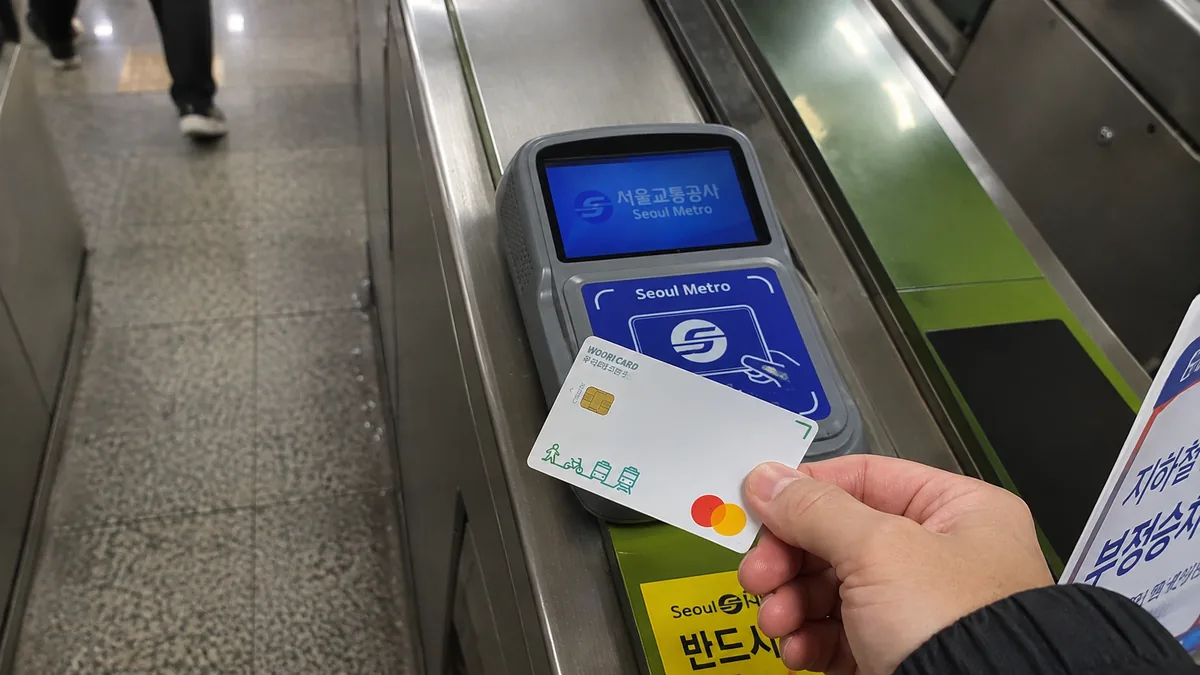
T-money is a rechargeable prepaid card. You tap it on subway gates and bus readers. The same card also works on the AREX airport train, in taxis that accept it, and at convenience stores.
It’s the only option here that also works outside Seoul. That matters if you plan any day trip, like Suwon or other Gyeonggi towns. I covered one of those in my Suwon day trip guide.
How much does T-money cost?
- The card itself: around 3,000 won (~US$2.20). Guides list 2,500 to 4,000 won depending on the seller and design, so don’t be surprised by small differences.
- The balance: loaded separately. The card starts empty.
- Subway fare: about 1,550 won (~US$1.10) for a basic ride in Seoul, with extra charges for longer distances.
My pick: Buy T-money at any convenience store in Korea, since they all sell it. How much to load depends on how long you’re staying, but a typical transit ride runs about 1,000-2,000 won (~US$0.75-1.50), so I’d tell a friend to start with just 10,000 won (~US$7) and top up from there.
For a 3 to 4 day Seoul trip, most guides suggest loading 30,000 to 50,000 won (~US$22–37). I’d start lower and top up, because it’s easy to add money at convenience stores and station machines. Leftover money can be refunded, but the refund has a fee of around 500 won (~US$0.40), and the card price is not refunded.
Local tip: buy the card at a convenience store such as CU, GS25 or 7-Eleven. Tell the cashier you want a T-money card and how much to load. Cash is the safest way to pay for the first load.
Why I still pick T-money first
- It works on the AREX airport train, which the Climate Card doesn’t. If you’re coming in through Incheon, my Incheon Airport to Seoul guide explains your options.
- It covers the Sinbundang Line, GTX and taxis, which the Climate Card excludes.
- You never have to do break-even math. You pay per ride and move on.
Climate Card Short-Term Pass: 1 to 7 Days in Seoul
The Climate Card short-term pass is a flat-fee unlimited pass for Seoul’s subway and Seoul-licensed buses. You buy a physical card first, then load a pass of 1, 2, 3, 5 or 7 days onto it.
Climate Card tourist pass prices
| Pass | Price | Approx. US$ |
|---|---|---|
| 1 day | 5,000 won | ~US$3.70 |
| 2 days | 8,000 won | ~US$5.90 |
| 3 days | 10,000 won | ~US$7.40 |
| 5 days | 15,000 won | ~US$11 |
| 7 days | 20,000 won | ~US$14.70 |
| Physical card (one-time) | 3,000 won | ~US$2.20 |
These prices come from several current guides, and VisitKorea, Korea’s national tourism site, lists the same figures for the longer passes. Because the first purchase includes the card, a 3-day pass really costs 13,000 won (~US$9.60) the first time.
Is the Climate Card worth it? A simple break-even
With T-money, a basic subway ride is about 1,550 won. Four paid rides cost around 6,200 won (~US$4.50), which is more than a 5,000 won 1-day pass. So the pass starts to win at roughly four paid rides a day.
That’s easy to hit if you’re doing Gyeongbokgung in the morning, Insadong for lunch, Hongdae in the afternoon and a late dinner in Seongsu. It’s hard to hit if you’re walking one neighborhood all day.
T-money gives transfer discounts, and distance changes the fare, so treat this as a rule of thumb rather than exact math.
Local tip: When I lived in Seoul, I rode the subway twice a day for my commute. If you’re traveling, 3-4 rides a day is usually enough, so the pass may only pay off if you hit the higher end of that range.
What the Climate Card does not cover
- AREX airport train. You can’t board it with a Climate Card.
- Sinbundang Line and GTX. Both are excluded, per VisitKorea.
- Anything outside Seoul. Seoul’s FAQ says the short-term pass is usable in Seoul only. The seven Gyeonggi cities that took part in the 30-day pass no longer have it either.
- Taxis, Ttareungi bikes and the Hangang bus. The bike and river bus options were add-ons to the 30-day pass, which is gone.
Local tip: the pass starts on the day you charge it, and you can’t load it in advance. It also doesn’t last 24 hours. Load a 1-day pass at 11 p.m. and you’ve bought yourself very little, so charge it on the morning you start sightseeing.
How to buy it
- Find a Seoul Metro station ticket machine, an information center in a station, or a participating convenience store near a station.
- Buy the 3,000 won physical card.
- Switch the machine to English, pick the Climate Card option, then choose your pass length.
- Tap in and tap out at every gate. Forgetting to tap out is a common mistake.
On payment: VisitKorea still notes that buying and charging are cash only. However, since March 17, 2026, Seoul has added kiosks at city-run stations where foreign cards work for the short-term passes. The fee is about 3.7%, according to Korean press coverage. Not every machine has this, so carry cash as a backup and check the VisitKorea transportation cards page.
K-Pass, Modu Card and Climate Pass: Not Your Pass
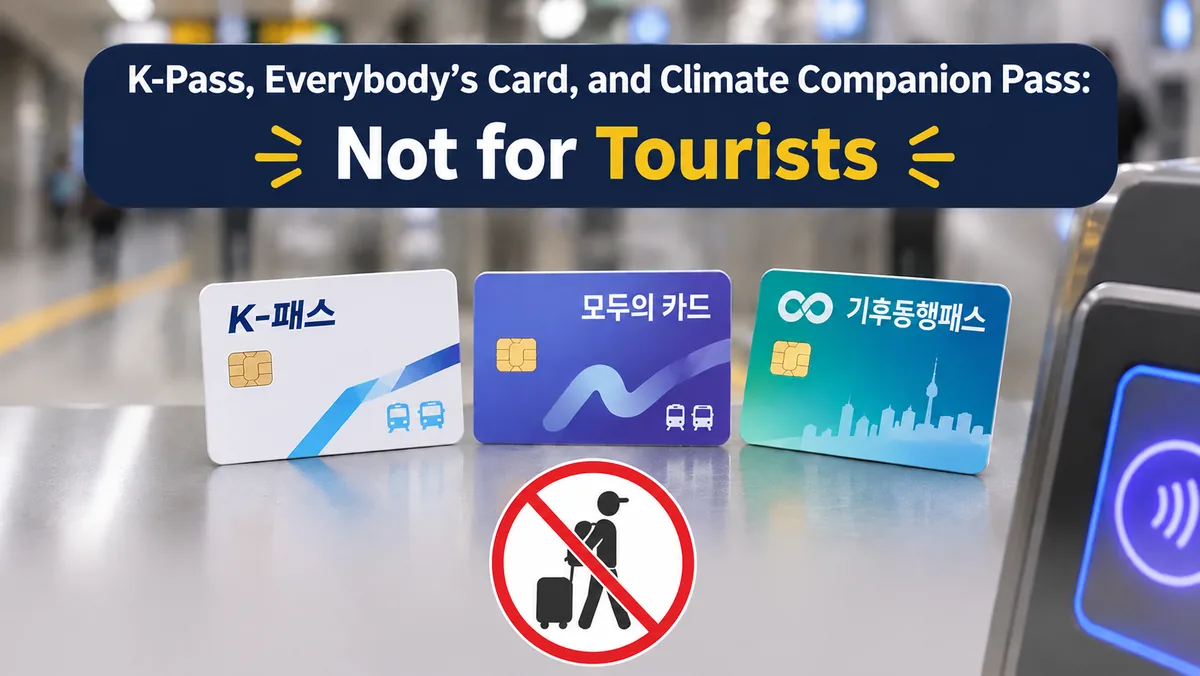
This is where most of the confusion comes from, so I’ll keep it simple. K-Pass (now being called Modu Card, or "Everyone’s Card") is a refund program. You ride normally, then get part of your fare back in a Korean bank account.
Seoul’s resident Climate Pass sits on top of that system. The city’s June announcement listed a flat-rate option of 62,000 won (~US$46) inside Seoul and 100,000 won (~US$73) for a wider metro range, with the system picking the better deal for residents.
For tourists, none of this applies. You need to register in the K-Pass system with a Korean identity check. Sources I found say foreigners need an alien registration number, which short-term visitors don’t have. Seoul officials also said the Plus benefits would be limited to registered Seoul residents.
If you’re moving to Korea for study or work, that’s a different story. I’d look at it after you get your ARC. For a vacation, ignore it.
Which Korea Transportation Pass for Tourists Fits Your Trip?
Here’s how I’d pick, based on how people usually travel.
| Your trip | Best pick | Why |
|---|---|---|
| 3 to 5 days, a few neighborhoods a day | T-money only | Simple, works at the airport, covers day trips |
| 3 to 7 days, packed Seoul itinerary, 4+ rides a day | T-money + Climate Card pass | Use T-money for AREX and trips out of Seoul, the pass for the city |
| Seoul plus Suwon or other Gyeonggi day trips | T-money only | The Climate Card stops at the Seoul border |
| Winter trip with light festivals outside Seoul | T-money | Gyeonggi places aren’t covered by the pass. See my winter light festival guide |
| Staying a few months | T-money now, then look at K-Pass with an ARC | Resident programs need registration |
If you’re a light traveler, don’t overthink this. Buying both cards on day one only makes sense if your plan really is heavy Seoul transit.
Mistakes I’d Help You Avoid
- Buying an old 30-day Climate Card. It’s discontinued, so don’t trust old posts.
- Expecting the Climate Card to work at the airport. It can’t board AREX, so bring T-money or buy a ticket for that leg.
- Loading a 1-day pass too late. It’s a calendar-day pass, not 24 hours.
- Using the pass outside Seoul. Day trips need T-money.
- Skipping the tap-out. Always tap when you leave, on both the subway and the bus.
- Only carrying a foreign credit card. Some machines accept it, but not all. Keep cash for the first purchase.
Local tip: rules for transit cards change fast in Korea. Before you buy, check the official sites linked above and the station machine itself.
FAQ
Can tourists use K-Pass or Climate Card Plus in Korea?
No. Both are resident systems that need Korean registration. As a visitor, use T-money, or a 1 to 7 day Climate Card pass if you’re staying in Seoul.
Is the Seoul Climate Card still available in 2026?
Only the short-term version. Seoul ended the 30-day and postpaid cards on October 1, 2026, but the 1, 2, 3, 5 and 7 day passes continue and work in Seoul only.
Is T-money or the Climate Card better for tourists?
T-money is better for most people because it works nationwide and on the airport train. The Climate Card can save money if you take about four or more paid rides a day inside Seoul.
Can I use the Climate Card to go to Suwon or Incheon Airport?
No. It’s valid in Seoul only and can’t board AREX. Use T-money for both.
Final Thoughts
For a Korea transportation pass for tourists, my honest pick is T-money for almost everyone, plus a short-term Climate Card pass only if your Seoul schedule is packed. Ignore K-Pass and the Plus branding unless you’re moving here.
If you have a question about your own route, send it through my Contact page. You can also read more about me and this blog.
Enjoy Korea!
— Woogie